Ruthagati AA – Kenya

EU* on orders over 75/99€

On Mondays and Wednesdays

Bratislava, Košická 21
Product detailed description
Small Farmers
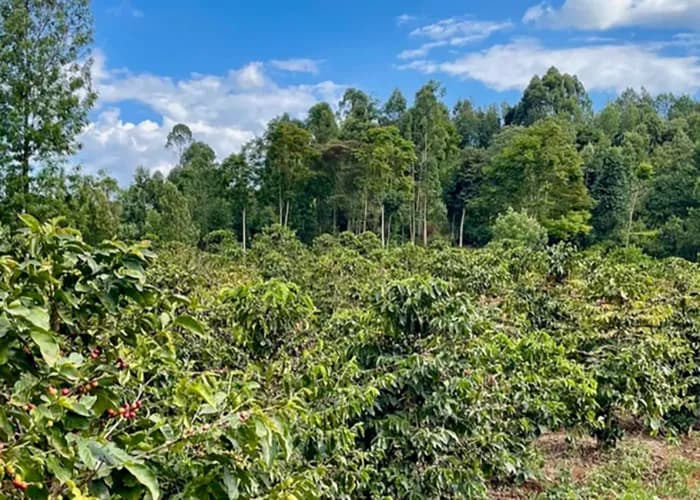
The Ruthagati Coffee Factory (wet mill) is one of the operational wet mills managed by the Rutuma Amalgamated Farmers’ Co-operative Society (FCS), situated in the Mathira sub-county of Nyeri, approximately 130 km north of Nairobi. Wet mill operations sit at roughly 1,650 to 1,750 meters above sea level, with delivering farms climbing higher up the foothills of Mount Kenya. Member smallholders deliver ripe cherries directly on foot or by small transport to the mill on the day of picking. Most contributing farmers tend small plots averaging around 150 coffee trees alongside shade and food crops (such as bananas, macadamia, and maize). Pristine river water diverted from Mount Kenya catchment streams feeds the pulpers and washing channels. Waste pulp is composted and distributed back to farmers as organic fertilizer, while wash water is routed through tiered settling/seepage pits to filter runoff naturally before returning to the watershed.
Harvest and Processing
Selective Reception & Hand-Sorting: Smallholders deliver red cherries harvested that morning. Cherries undergo flotation to skim off low-density "mbuni" (floaters/underdeveloped cherries) and hand-sorting for defects before hitting the hopper.
Disc Depulping: A multi-disc pulper strips the skin and outer pulp, mechanically separating the coffee into density streams (Grades 1, 2, and 3).
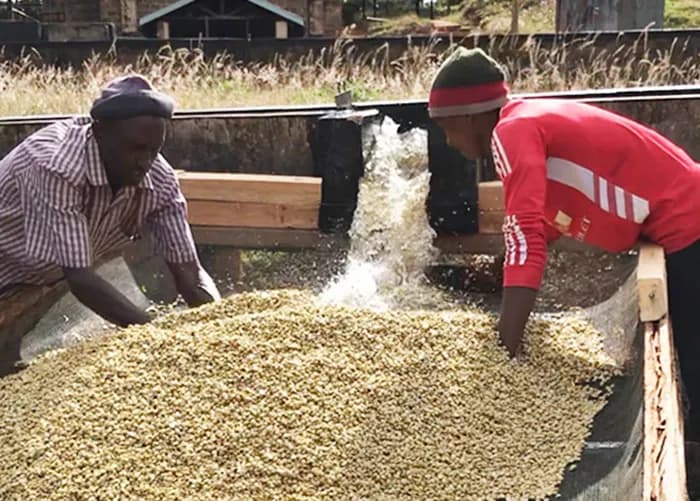
Double Fermentation: Depulped seeds rest in concrete fermentation tanks under ambient shade for roughly 16 to 24 hours to break down the dense mucilage enzymatically. They are then washed with fresh water and often steeped under cold, fresh river water for an additional 12 to 24 hours. This clean soak removes residual sugars and promotes the trademark clean cup and high organic acid definition of central Kenyan coffees.
Grading Channels: The clean parchment is agitated along inclined concrete washing channels. Denser beans sink early (destined for AA and AB sorting), while lighter seeds wash further down the flume.
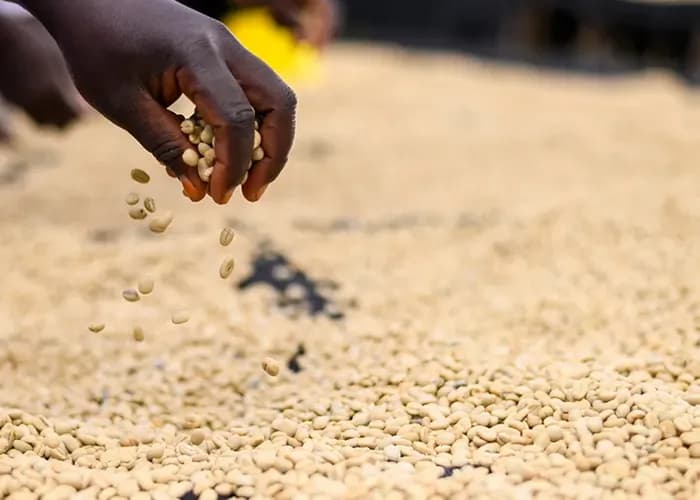
Slow Sun Drying: Parchment dries on raised African timber and mesh beds over 10 to 18 days, depending on humidity and cloud cover. The parchment is turned continuously throughout the day and covered with breathable netting during the midday heat peak to prevent split parchment, as well as at night to protect against cold condensation and mountain dew.
Dry Milling & Grade AA Separation: Once conditioned to an optimal 10–11% internal moisture, the parchment rests in conditioning bins before dry milling in Karatina or Nyeri, where mechanical sizing screens sort the AA lot (screen size 17/18, 7.2 mm hole diameter).
About this Coffee
Cupping score: 88.00
Washing Station: Ruthagati
Producer: regional small farmers
Region: Nyeri
Altitude: 1750 – 1900 masl
Variety: SL28, SL34, Ruiru 11
Processing: washed
Crop: 2025/2026
About the Variety
SL28 was bred by Scott Laboratories in 1931 from the Tanganyika D.R. variety. It has become very popular across Kenya and is recognized as a variety with exceptional cup quality. It has broad leaves with copper tips and large beans. SL 34 is a French Mission mutation that originated on the Loresho Estate in Kabete. SL34 has broad leaves with bronze tips. It is grown throughout Kenya. SL34 is prized for its high productivity across various climates and wide altitude ranges. It is said to be resistant to drought and heavy rains.
Kenyan Process
The cherries are first pulped to remove the beans, then fermented, washed—sometimes in multiple cycles—and soaked in water. The bean is then dried and rested on specially constructed raised beds.